


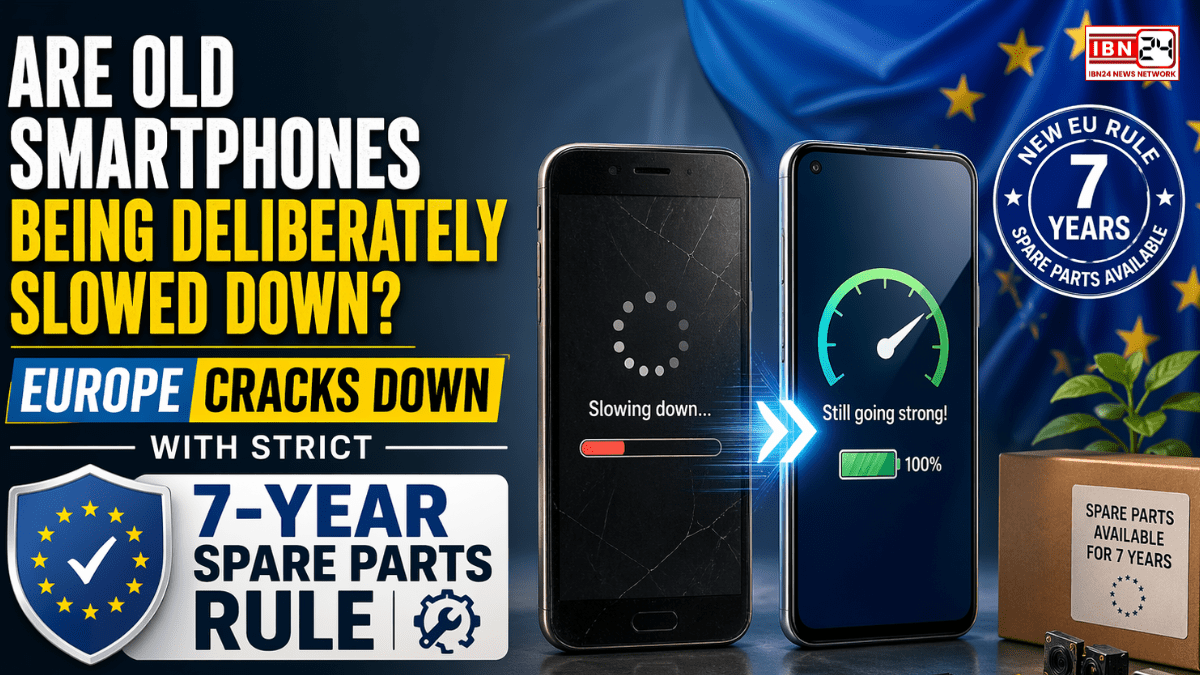
Have you ever noticed that your once lightning-fast smartphone starts to crawl after a couple of years? The battery drains quickly, apps freeze, and eventually, you find yourself frustrated enough to buy a new one. This common experience has led to a growing suspicion among consumers: are old smartphones being deliberately slowed down to push new sales? The European Union (EU) certainly thinks so, and they are taking significant steps to curb this practice, known as ‘planned obsolescence,’ with a strict new 7-year spare parts rule .
The Deliberate Slowdown: A Manufacturer’s Tactic?
For years, many users have felt that their devices perform worse over time, often coinciding with the release of new models. In 2017, Apple Inc. admitted to deliberately slowing down older iPhones. While the company claimed this was for
‘battery protection,’ consumers perceived it as an unfair tactic to pressure them into upgrading. This led to Apple implementing a battery health indicator, but the underlying issue of planned obsolescence remained .
According to a report by the EU’s Joint Research Centre, smartphones are typically replaced every 2-3 years, a cycle that the EU believes is artificially shortened by manufacturers .
Europe’s New Rules: A Game Changer for Smartphone Longevity
To combat planned obsolescence and promote sustainability, the European Union will implement stringent ‘Ecodesign’ regulations starting February 2027. These new rules aim to hold companies accountable and significantly extend the lifespan of smartphones. The regulations can be categorized into four main areas :
1. Battery Life and Capacity: Every smartphone battery must retain at least 80% of its capacity after 800 charge cycles. This means that even after years of use, the battery backup should not drastically diminish.
2. 7-Year Spare Parts Support: Manufacturers will be required to make spare parts available for up to 7 years after a model is discontinued. Furthermore, companies must ensure delivery of these parts within 5-10 working days.
3. Repair Rating: Similar to energy efficiency ratings on appliances, phones will now feature a ‘repair rating’ (A to E). This rating will inform consumers about how easy it is to repair a phone if it breaks down.
4. 5 Years of Software Updates: Smartphone companies will be mandated to provide software updates for at least 5 years, ensuring that older phones do not fall behind in terms of security and features.
Impact on Consumers and the Market
The implementation of these new rules in Europe is expected to have a significant positive impact. It is estimated that the average lifespan of a smartphone in Europe will increase from 3 years to 4.1 years. This extended lifespan is projected to save European households approximately ₹10,700 (98 Euros) annually by 2030 .
Why Has Smartphone Repair Become So Difficult?
Manufacturers have increasingly adopted sealed designs in the name of thinner phones, better waterproofing, and easier manufacturing. This approach gives companies complete control over repairs. For instance, if an unauthorized shop replaces an iPhone battery, the phone may display warnings and disable certain features. Some Pixel models experienced battery swelling issues, leading to software updates that limited charging and offered replacements .
Implications for Indian Consumers
While these regulations are specifically for Europe, smartphone companies typically do not design different hardware for different countries. Therefore, the changes implemented in Europe are likely to benefit Indian consumers as well, leading to more durable and repairable smartphones in the Indian market .
Remaining Challenges
Despite these advancements, some challenges remain. While the ‘Corrective Act’ will facilitate screen replacement, users may not be able to replace it themselves. Technologies like ‘part pairing’ could still hinder third-party repairs .
The Real Question: Who Controls a Phone’s Lifespan?
This debate is not just about batteries or screens; it’s about control. Until now, companies largely dictated when your phone would become ‘obsolete’—when software support would end, or when repairs would become difficult. The EU’s new rules are an attempt to return this power to the consumer. If successful, this could significantly shift the balance in the smartphone market, giving consumers more say in the longevity of their devices
Read More: SSC Jobs 2026: 3003 Government Vacancies Announced – Apply Now!
Youtube: https://youtube.com/@IBN24NewsNetwork?si=ofbILODmUt20-zC3
Instagram: https://www.instagram.com/ibn24newsnetwork
Facebook: https://www.facebook.com/ibn24newsnetwork/
Twitter: https://x.com/IBN24Network?t=K1A8JK8CUwcgllMRYQNPOw&s=08