

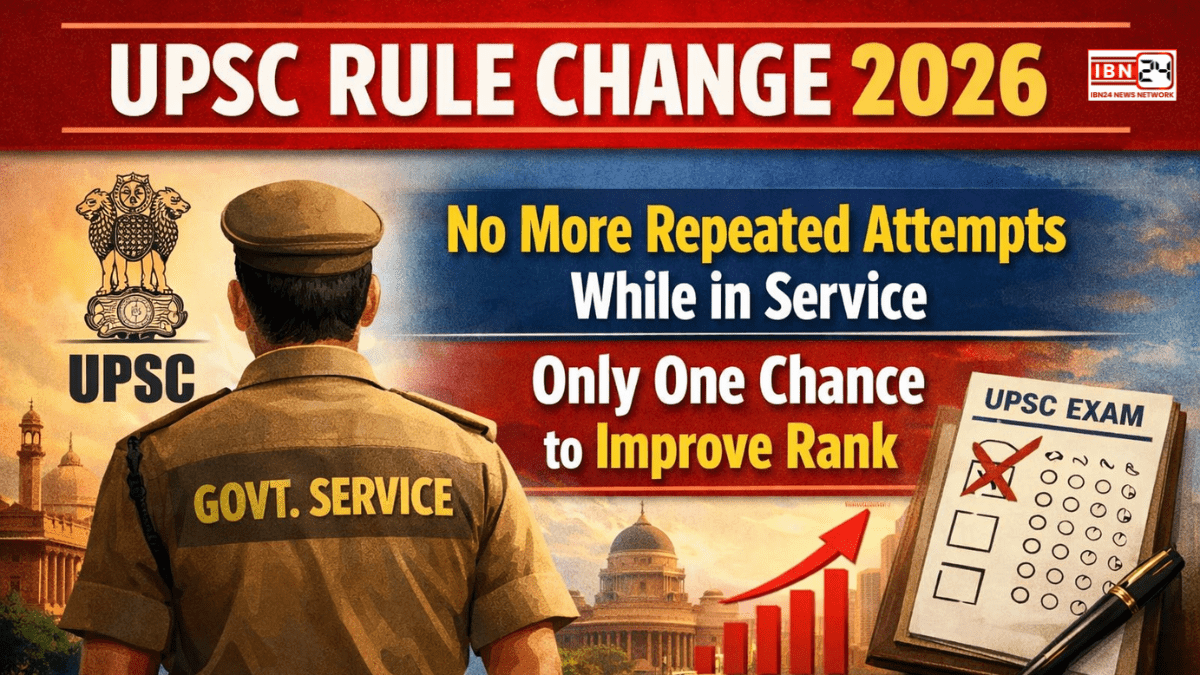
In a historic policy change, the Union Public Service Commission (UPSC) has brought significant changes in the rules of eligibility and attempting in the Civil Services Examination (CSE) 2026 – turning the competitive scene of the aspirants on its head (and even on its serving officers). Among such changes, one of the most influential ones is the limitation of repeat attempts during the service, which practically put an end to the previous tradition when officers could keep taking UPSC exams each year and remain at the workplace without leaving the position.
Why the New Rule Matters
Over the decades, the UPSC has permitted candidates who have been appointed to civil services to rewrite the CSE even after joining service, particularly those who have been appointed to the Group A service, such as the Indian Administrative Service (IAS), Indian Police Service (IPS) and Indian Foreign Service (IFS). Most of the officers joining a service chose to re-examine in the following year in order to better their All-India Rank (AIR) or have a more desirable service/cadres. This not only increased the time of preparation but it also confused the boundary between being a bureaucrat and trying again to get a better posting.
The 2026 notification ultimately codifies a more organised and demanding attempt scheme – particularly to serving officers – to place firm boundaries on how and when a prospective member can remake CSE following recruitment to a service.
What the New Attempt Rule Says.
The following is a summary of what has been brought by the UPSC notification:
📌 1. IAS and IFS Cannot Reemerge as serving officers.
In case a candidate is already serving or serving in the Indian Administrative Service (IAS) or Indian Foreign Service (IFS), he is not even allowed to appear in CSE 2026. This is applicable at any of the stages – even in case the appointment is made after having cleared the Prelims, but before the Main exam.
This implies that since you get into these elite services, it practically becomes closed to the recurring offers before you could first resign out of service.
📌 2. IPS Officers Have the option of trying but with limitations.
Applicants who were already in the Indian Police Service (IPS) can, nevertheless, apply CSE 2026 again – but not be re-allotted to the IPS again on the new basis. They can however compete with other Group A services as long as they can qualify.
Once again, freedom to switch or re-try multiple times is no longer open to one, as is also a deterrent to the use of the exam cycle as a continuous rank-improvement strategy when one is in a service post.
📌 3. Single-Opportunity Improvement Prospective of newly selected officers.
The structured one-time improvement opportunity, perhaps the most talked about aspect of the new rule, is provided. In a CSE 2026 selection with a service (note in particular IPS or another Group A service) assigned, you will be permitted to take CSE 2027 once, provided you obtain a one-time exemption, on obtaining a one-time exemption, you must forgo the immediate commencement of your training.
This exemption means:
- You will be not joining the training until you are allocated the service.
- To enhance your AIR, you may take the following year CSE.
- Assuming you succeed once again in CSE 2027 – you decide on the service allocation between the 2026 and 2027.
- However, you cannot show up in CSE 2028 or later without resigning out of service.
This literally reduces your number of in-service attempts to a single area of improvement, which is a drastic contrast to the open-ended attempts of the past years.
📌 4. What Will You Do If You Do Not join or take exemption?
When a candidate does not attend training or request the exemption, CSE 2026 cancels entirely his or her service allocation.
On the same note, when a candidate can be found to reappear in the CSE 2027, but does not express commitment to implementing the selected service training, the two service allocations (2026 and 2027) are all cancelled.
These requirements will ensure that the candidates do not cheat their way through the system, that is, staying stuck to a service allocation but re-entering the rank ladder again and again.
📌 5. Applicants of CSE 2025 or Before Have One Final Bite.
Individuals who were selected in CSE 2025 or prior and are already in service have been given a one-time opportunity to participate in CSE 2026 or CSE 2027 without resignation. However, to appear in CSE 2028 or later resignation will be a prerequisite.
What This Implies on Aspirants.
This amendment to the rule has far-reaching effects:
- Aspirants who are serious and depend on repeated attempts currently are under a considerably stricter deadline and decision pressure.
- Career planning is even more imperative – particularly when deciding to enlist in a service or not or postponing to get a chance of advancing the rank.
- The desire to achieve a high rank in the first few attempts is many times greater, and preparation strategies are even stronger.
Conclusion
The UPSC Rule Change 2026 is a paradigm shift in the way that aspiring civil servants as well as serving officers can go about the Civil Services Examination. Limiting the possibilities of repetitive in-service and offering a single attempt of improvement will move the competition towards more sophisticated and organized application of examination cycles by UPSC.
To aspirants in all parts of India this is not merely an administrative change, but more strategic. This rule is now more than ever the key to understanding the implications of learning to plan your UPSC journey.
Youtube: https://youtube.com/@IBN24NewsNetwork?si=ofbILODmUt20-zC3
Instagram: https://www.instagram.com/ibn24newsnetwork
Facebook: https://www.facebook.com/ibn24newsnetwork/
Twitter: https://x.com/IBN24Network?t=K1A8JK8CUwcgllMRYQNPOw&s=08